
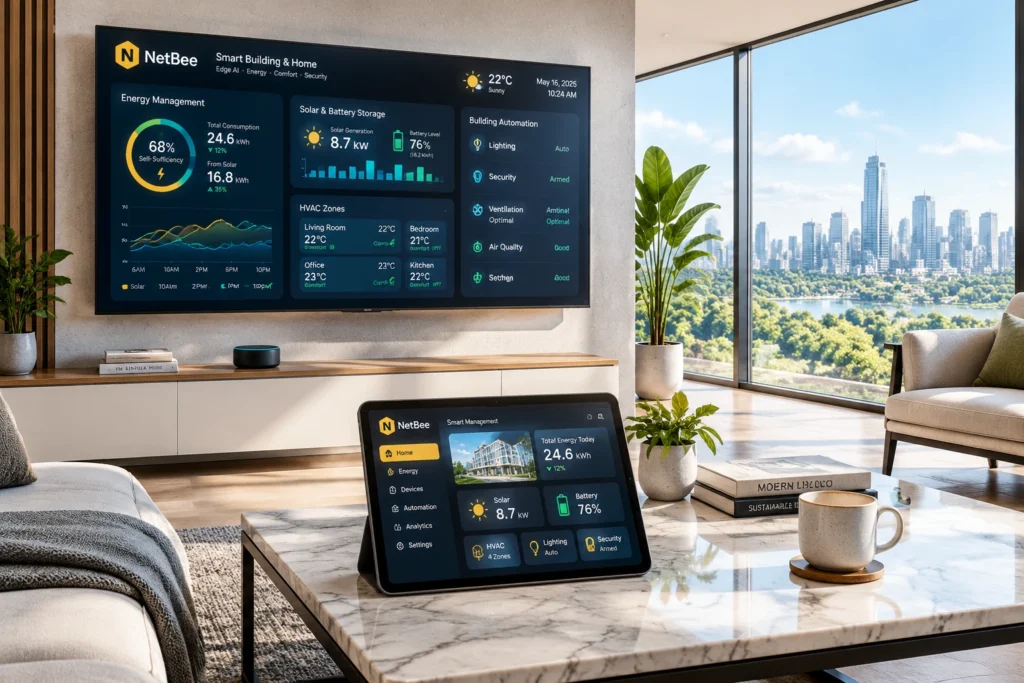
Next-Generation Smart Buildings: Integrating Edge AI and Open Automation Standards
The building automation industry has reached a defining milestone. The era of treating smart homes as a random collection of Wi-Fi plugs, standalone smartphone apps, or isolated gadgets has come to an end. Globally, two technological transformations have rewritten the rulebook for modern residential and commercial architectures: the maturation of open interoperability standards such as Matter (across its 1.4 and 1.5 milestones) and the migration of computational intelligence directly to the network edge via Edge AI.
The advanced NetBee platform bridges industrial hardwired dependability with flexible wireless protocols, offering an all-in-one ecosystem engineered for today’s living comfort and tomorrow’s sustainability standards.

1. Why Fragmented Legacy Automation Falls Short
For decades, building services operated in functional silos. Heating, ventilation, and air conditioning (HVAC), architectural lighting, perimeter security, and surveillance systems were governed by disconnected controllers and isolated software. This segregation created recurring operational hurdles:
- Energy and occupancy telemetry could not be shared across systems in real time.
- Total reliance on remote cloud servers left residents vulnerable whenever internet links suffered downtime or high latency.
- Equipment wear, peak demand charges, and long-term maintenance costs multiplied across disparate vendor stacks.
As explored in our detailed guide on smart home automation, the sustainable remedy lies in deploying a unified software brain and centralized dashboard that orchestrates every physical space into autonomous, coordinate zones.
2. The Transformative Role of Edge AI: Offline Autonomy and Instant Response
Cloud computing remains valuable for long-term fleet analytics, but mission-critical building management demands local execution. Edge computing and localized AI processing fundamentally elevate reliability:
- Total Local Autonomy (100% Uptime): Within the NetBee architecture, core logic, rule engines, and trigger responses run locally on an on-premise gateway. Essential security routines, ambient lighting, and climate control continue executing seamlessly even during complete external internet disruptions.
- Sub-Second Incident Response: During safety-critical events—such as natural gas leakage, early smoke detection, or perimeter breaches—every millisecond counts. Processing events at the edge eliminates round-trip cloud latency, empowering the system to trigger solenoid emergency shutoff valves or local alarms within milliseconds.
- Maximum Data Privacy: Resident movement patterns, occupancy behaviors, and license plate recognition feeds are analyzed within the encrypted local subnet, preventing sensitive daily living data from escaping to external servers.
3. Convergence of Global Standards: Matter, KNX, and Zigbee
While industry bodies like the Connectivity Standards Alliance (CSA) have expanded device interoperability with Matter, high-end architectural engineering relies on selecting the right transport medium for the right phase of construction:
- KNX Hardwired Infrastructure: The gold standard for newly constructed luxury estates and commercial facilities, offering immune resistance to radio interference and decades of field-proven resilience.
- Zigbee Wireless Protocols: The ideal non-destructive deployment path for existing homes and renovation projects, requiring zero wall cutting or structural rewiring.
- NetBee Unified Abstraction Layer: NetBee normalizes these protocols into a cohesive software dashboard, letting operators supervise zones via in-wall touch displays, web portals, or mobile interfaces regardless of original equipment manufacturers.
This unified approach scales effortlessly from residential properties to large-scale operations, forming the identical engineering backbone NetBee uses for industrial IoT, telemetry, and smart factory automation.
4. Intelligent Energy Management and Dynamic Tariff Optimization
Modern building intelligence extends far beyond scheduled on/off timers; it focuses on dynamic load balancing and carbon-aware energy management:
- Millimeter-Wave & Optical Presence Sensing: High-fidelity presence sensors distinguish between vacant and occupied spaces, autonomously transitioning HVAC and illumination to Eco Mode.
- Coordinated Solar and Storage Management: Integrating rooftop photovoltaics, battery energy storage systems (BESS), and grid connections on one screen enables automated peak shaving—shifting heavy power loads to low-cost tariff windows.
- Predictive Maintenance: Continuous thermal, vibration, and power draw monitoring detects anomaly trends across chillers, circulation pumps, and elevators well before sudden hardware failures occur.
Comparison Table: Legacy Automation vs. NetBee Edge AI Smart Building
| Performance Indicator | Legacy / Cloud-Only Systems | NetBee Modern Edge AI Ecosystem |
|---|---|---|
| Computing Architecture | Dependent on remote public cloud | On-premise local Edge processing |
| Internet Dependency | Routines fail or lag during internet loss | 100% autonomous local execution 24/7 |
| Protocol Compatibility | Proprietary vendor lock-in & fragmented apps | Multi-protocol integration (KNX, Zigbee, Web APIs) |
| Energy Optimization | Manual switches and static timers | Dynamic adaptation based on presence & real-time tariffs |
| Emergency Mitigation | Delayed notifications and cloud alerts | Millisecond shutoff of valves, local alarms, instant push alerts |
5. Professional Implementation Roadmap: From Blueprint to Handover
- Architectural Analysis & Requirements Gathering: Reviewing floor plans, calculating electrical loads, and specifying comfort, lighting, and security requirements per zone.
- Network Topology & Protocol Selection: Designing the optimal hybrid infrastructure (hardwired KNX vs. wireless Zigbee mesh) according to building progress.
- Hardware Deployment: Commissioning localized automation servers, smart wall touch panels, environmental sensors, and motorized shutoff valves.
- Rule Engine & Scenario Programming: Tailoring custom automated routines (Departure, Sleep, Hosting, and Eco optimization) within the NetBee management panel.
- System Validation, Handover, and Lifecycle Support: Executing end-to-end network stress tests, provisioning role-based administrative credentials, and delivering around-the-clock technical support.
Conclusion and Expert Engineering Consultation
Scientific building smartization is not an aesthetic novelty—it is a strategic capital investment with proven ROI that reduces utility expenditure, curtails mechanical depreciation, and delivers lasting peace of mind.
To review architectural plans, request system sizing, and obtain a free technical consultation from our engineering specialists:
- Official Website: netbee.online
- Smart Home Solutions: NetBee Smart Home Portal
- Social Channels (Eitaa, Bale, Telegram, Soroush):
@netbsign